


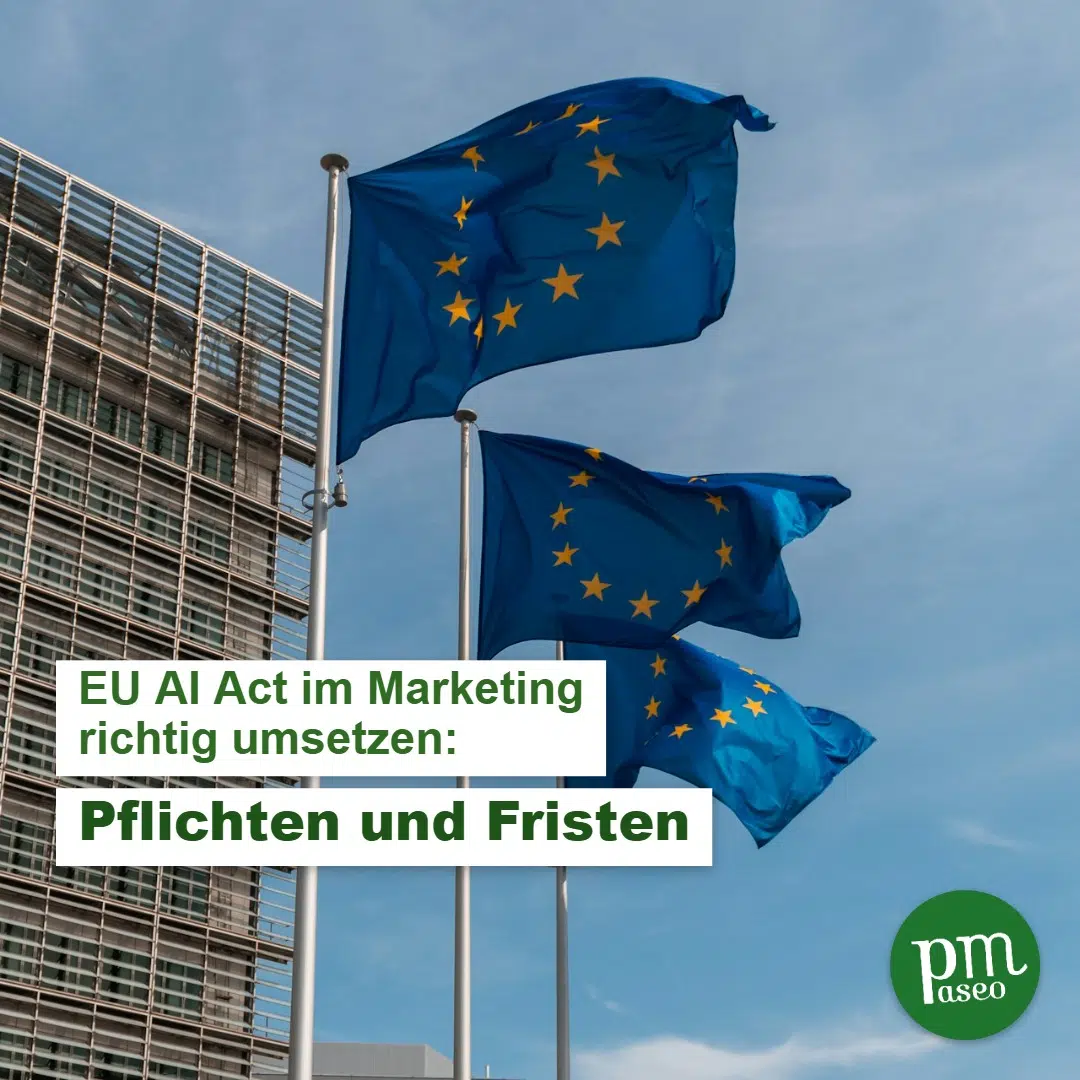
As of August 2, 2026, a new requirement applies to your marketing. Anyone who publishes AI-generated content must often label it as such. This applies to images from image generators, text from ChatGPT, and chatbots on your website. Many marketing teams are still largely unaware of this. This is exactly where the EU AI Act comes in. It is the world’s first comprehensive regulation for artificial intelligence. For you, this means clarity, not panic. Here, you’ll learn which rules actually apply to marketing. You’ll become familiar with the four risk classes. You’ll understand the key deadlines leading up to 2027. And you’ll receive a concrete roadmap for implementation. We’ll show you how to meet the transparency requirements. At the same time, we’ll be honest about where the regulation falls short. This way, you can explain the new strategy to your executive team with confidence.
Key Points at a Glance
- The EU AI Act has been in effect since August 1, 2024.
- He classifies AI systems into four risk categories.
- Transparency requirements for AI-generated content have been in effect since August 2, 2026.
- The labeling applies to images, videos, text, and chatbots.
- Violations may result in fines of up to 35 million euros.
- Article 4 requires all employees to have AI literacy.
1. What is the EU AI Act?
With the EU AI Act, the European Union is introducing the first binding legal framework for artificial intelligence. The regulation is intended to ensure that AI remains safe and transparent in the EU. It applies not only to companies based in the EU; it affects anyone whose AI systems are used in the EU market. The Commission presented the proposal back in 2021. The regulation took effect on August 1, 2024. This is confirmed by the European Commission’s official digital strategy.
At the heart of the regulation is a risk-based approach. The EU does not assess AI across the board. Instead, it tailors the requirements to the risk posed by a given application. The higher the risk, the stricter the requirements. This is good news for your marketing. Most marketing tools fall into low-risk categories. Nevertheless, clear transparency rules apply to these tools.
In a Nutshell: What Is an AI System?
The EU AI Act defines an AI system in Article 3. It refers to a machine-based system with a certain degree of autonomy. It uses inputs to determine how to generate outputs. Such outputs include, for example, text, images, recommendations, or decisions. Your newsletter tool with AI-powered text suggestions already falls into this category.
Numbers that speak for themselves:
-
35 million euros:Fines for prohibited practices can reach up to this amount. Alternatively, a fine of 7 percent of annual revenue may be imposed (Source: MHP, 2025).
-
69 percent: That is the percentage of companies that need help with the AI Regulation (Source: Bitkom study, 2024).
-
About 190 organizations have signed the EU Code of Conduct on Transparency (Source: European Commission, July 2026).
-
August 2, 2026. As of this date, transparency requirements for AI-generated content are in effect (Source: European Commission).
2. You Need to Know These Deadlines
The rules of the EU AI Act do not take effect all at once. They will be phased in gradually. This phased approach gives companies time to prepare. Four deadlines are particularly important for your marketing efforts. The consulting firm MHP clearly summarizes these deadlines in its blog post on the EU AI Act.
As of February 2, 2025, AI systems posing an unacceptable risk are prohibited. Companies must remove such systems from the market. As of August 2, 2025, the rules apply to general-purpose AI models. These include large language models such as the one behind ChatGPT. Our article on ChatGPT Shopping highlights the opportunities ChatGPT offers in retail. As of August 2, 2026, two additional provisions take effect. First, strict obligations for high-risk systems come into force. Second, the transparency obligations under Article 50 take effect. It is precisely this article that directly affects your marketing. Finally, existing AI models must comply by August 2, 2027.

3. The Four Risk Categories in Marketing
Risk assessment is at the heart of the regulation. Every AI system in use is assigned one of four categories. Different requirements apply to each category. We’ll help you understand how these categories apply to your day-to-day marketing activities.
Unacceptable Risk
These systems are completely prohibited. This includes, for example, evaluating people based on their social behavior. Manipulative systems also fall into this category; they exploit the vulnerability of certain individuals. Reputable marketing practices do not use such methods in the first place.
High Risk
High-risk systems have a profound impact on people's rights. One example is software used to screen job applicants. This category rarely plays a role in pure marketing. It becomes important at the intersection with human resources. If you use AI in recruiting, examine this category closely.
Limited Risk
This category is central to your marketing efforts. It includes chatbots and synthetic content—that is, AI-generated images, videos, and text. These are subject to transparency requirements. Users must be able to recognize that they are interacting with AI. The content itself must also be labeled. You can read more about this in the next section.
Minimal risk
Most tools fall into this category. These include spam filters and spell-checkers. Content recommendation algorithms also fall into this category. The EU does not impose any specific requirements in this area. However, it recommends a voluntary commitment.
Important Note
The EU AI Act deserves both praise and criticism. First, the praise: Clear transparency rules strengthen user trust. This is a real competitive advantage for reputable marketing.
Now for the uncomfortable truth. The EU is regulating a technology over which it has little control. Almost all of the large AI models originate in the U.S. Their data flows into the systems of a handful of corporations. Europe sets the rules but remains technically dependent.
In addition, the regulation is coming under pressure. In November 2025, the Commission proposed simplifications. Critics see this as a watering down of the regulation due to massive lobbying pressure. We therefore advise staying calm but not turning a blind eye. Use AI, but not just because of the hype. Don’t automate content completely without human oversight. Those who have every text reviewed by a human come out ahead in two ways: they comply with the rules and deliver better quality.

4. Article 50: Mandatory Labeling of AI Content
Article 50 is the most important provision for your marketing. It governs transparency in generative AI. These obligations have been in effect since August 2, 2026. The European Commission confirms this in its Code of Conduct on the Transparency of AI Content. The goal is to protect against deception and manipulation.
This has three practical implications for your marketing. First, chatbots must be clearly identifiable as AI. A service bot must not pose as a human. Second, you must label so-called “deepfakes”—images, videos, or audio recordings that are deceptively realistic. Third, certain AI-generated texts must be labeled. This applies to texts on topics of public interest.
There is one important exception when it comes to text. If a human editor reviews the text, the disclosure requirement does not apply. The prerequisite is genuine editorial responsibility. This is exactly where your opportunity lies. If you consistently edit AI-generated text, you remain flexible. At the same time, the quality of your content improves noticeably. Our guide shows you how to write AI-generated text that truly attracts visitors.
Real-World Example: Your AI Image on the Landing Page
You create an advertising image using an image generator. The image depicts a photorealistic person. In this case, the transparency requirement applies. You should label the image as AI-generated. The EU even provides its own symbols for this purpose. You can find these icons on the European Commission’s website. Clear labeling protects you and builds trust. Read more about AI in advertising and social media in the linked article.
At first glance, the certification may seem like a burden. In reality, it is a sign of trust. While adherence to the Code of Conduct is voluntary, the obligations under Article 50 are binding law. As of the end of July 2026, approximately 190 organizations had signed the Code, demonstrating its broad acceptance within the industry.

5. AI Literacy: The Underestimated Responsibility
One point often gets overlooked in the debate. Article 4 requires what is known as “AI literacy.” This refers to your employees having sufficient AI competence. Your team must use AI safely and responsibly. This requirement has been in effect since February 2025.
In concrete terms, this means the following for your marketing: Train your editorial team on how to work with AI. Explain the limitations and risks. These include, for example, fabricated facts in AI-generated texts. Experts refer to this problem as “hallucination.” Proper training reduces this very risk. The need is real. According to a 2024 Bitkom study, 69 percent of the companies surveyed need support with the AI regulation.
6. Five Steps to Implementation
Theory is one thing; putting it into practice is another. This roadmap will help you stay on track. It's also suitable for small marketing teams.
Step 1: Identify AI systems
Start by getting an overview. Make a list of every AI tool used in marketing. Think of text generators, image AI, and chatbots. AI features in your standard tools count, too.
Step 2: Assign Risk Classes
Assign a risk class to each tool. Most will fall into the "limited" or "minimal" risk categories. Mark all tools that require labeling.
Step 3: Implement Labeling
Establish a clear standard. Define how you will label AI-generated content. Use consistent labels or the EU symbols. This will ensure your labeling is transparent.
Step 4: Train the team
Meet the AI literacy requirement. Provide your team with regular, hands-on training. Keep thorough records of these training sessions.
Step 5: Document Processes
Put your rules in writing. Clearly define responsibilities. This way, you can demonstrate that you’ve exercised due diligence at all times. This will protect you from fines in the event of an emergency.
Transparency is your competitive advantage
The EU AI Act isn't a one-time project. It's an ongoing process for your marketing. The key obligations are manageable. Take inventory of your tools, assess risks, and label AI-generated content. Train your team and document everything thoroughly.
Don’t view the rules as an obstacle. Use transparency as a clear sign of trust. That’s exactly what your customers expect today. Those who are open about AI stand out from the competition. It’s best to get started this week. Create an initial list of your AI tools. Then, work with your team to clarify any outstanding questions. Would you like some help with this? At Paseo Marketing, we’ll guide you honestly and as equals.
Questions and Answers on the EU AI Act in Online Marketing
What is the EU AI Act?
When does the labeling requirement for AI-generated content take effect?
Do I need to label ChatGPT-generated text in marketing?
What penalties apply for violations?
What does AI literacy mean for my team?

Would you like to prepare your business for Google ChatGPT and Perplexity today?
Paseo Marketing, based in Karlsruhe, provides honest, peer-to-peer consulting to German companies, small and medium-sized businesses, and B2B "hidden champions." We don't shy away from addressing uncomfortable issues and work with you to implement solutions. Request your free initial consultation now!
Alexander Keller
Chief Search Architect
kontakt@paseo-marketing.de
0721 – 911010


