


Paseo / Values
Our values
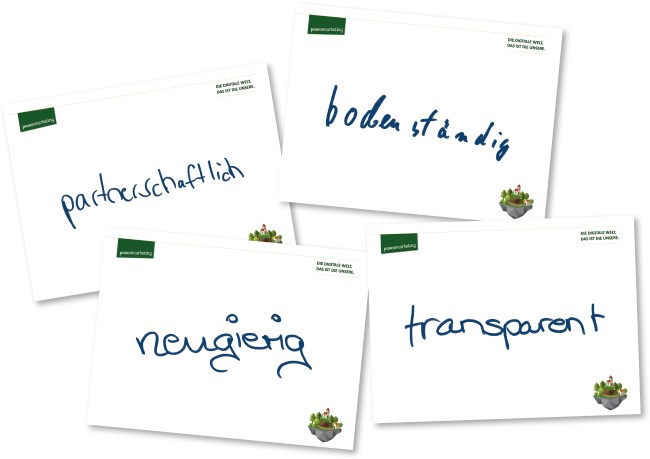
What do the four adjectives mean specifically?
In partnership
- We treat customers and colleagues with respect.
- We treat customers and colleagues as equals.
- We regularly exchange information with customers and colleagues.
- We share our knowledge.
- We are open to criticism from customers and colleagues.
- We set goals together with customers and colleagues.
- We are not yes-men and we call uncomfortable things by their name.
- We provide support, advice, and implementation.
Down-to-earth
- We honestly express our opinion.
- We don't promise more than we can deliver.
- We work professionally.
- We are authentic.
Transparent
- We say what we do and do what we say.
- We share our knowledge with customers and colleagues.
- We are open to mistakes.
- We have clear responsibilities.
- We measure ourselves against jointly agreed goals.
Curious
- We are interested in our customers, their products, and their concerns.
- We place great importance on continuing education.
- We like to stray from the beaten path.
- We see ourselves as a source of ideas.

Who established the corporate values?
Two things were clear from the outset: the conviction that a project such as defining corporate values can only be meaningful and purposeful if all employees are involved. And secondly, the certainty that the undertaking would require sufficient time. That is why the process spanned several months. Between the individual phases, there was always ample opportunity to reflect extensively on what had been achieved, to let it sink in, and then to tackle the next stage with renewed vigor and new ideas—also with the help of an external expert. Their task and skill was to moderate and question the process from the perspective of an outsider and uninvolved party, and ultimately to bring everything together into a coherent whole.
Phase 1: The Trainee Project
It all started with a trainee project. The idea behind it was that young age and relatively short length of service in the company ensure an unbiased, uninhibited view. So the task assigned to the young people was simply to put into words how they experience the company on a daily basis—how they feel about their colleagues, how the office affects them, how they perceive the atmosphere during customer visits, and so on. They collected all of this information and presented the results to the entire workforce.
In retrospect, what is astonishing is that the characteristic features of the company put down on paper by the trainees overlap greatly with the corporate values ultimately compiled and agreed upon by all employees. The enthusiasm and seriousness with which the trainees tackled the project as their own led to a follow-up task: Since then, the trainees have become the guardians of the company values, so to speak. With a keen eye, they now constantly check whether all activities are in line with the values. This starts with the selection of coffee beans and goes far beyond the quality of the IT infrastructure.
Phase 2: The workshops
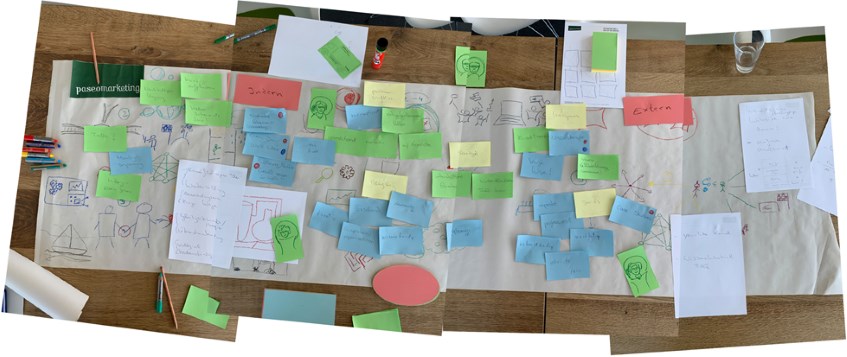
To kick off the second stage of the process, a half-day workshop was held with all employees—with an external expert, but without the company boss. The former was to have someone on board who had already accompanied the process of developing corporate values countless times, as well as to have an objective voice from outside the corporate world. The latter was to ensure that everyone could freely express their views on the matter. After all, the aim was not to determine how the boss wanted to see his company, but how the employees actually saw their workplace and which values they identified with themselves and the company.
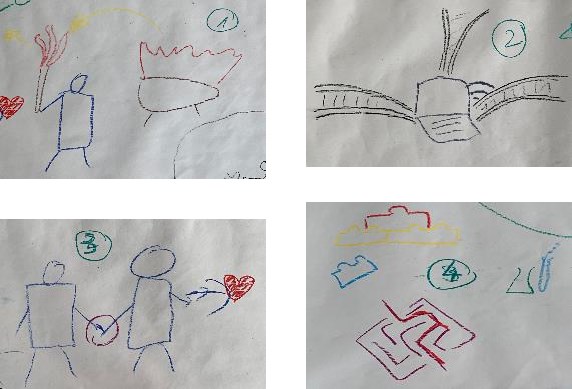
In part one of the workshop, the focus was on expressing one's own feelings in the form of drawings. Drawings were chosen because visualizing content is not part of everyday tasks, and this unfamiliar activity represents a step away from everyday life, sharpens the senses, and promotes creativity. The focus was not on aesthetic beauty, but on symbolism—for example, that employees see themselves as torchbearers of online knowledge and carry this knowledge to customers, or that they find the right way through the online labyrinth.
Phase 2: The workshops
To kick off the second stage of the process, a half-day workshop was held with all employees—with an external expert, but without the company boss. The former was to have someone on board who had already accompanied the process of developing corporate values countless times, as well as to have an objective voice from outside the corporate world. The latter was to ensure that everyone could freely express their views on the matter. After all, the aim was not to determine how the boss wanted to see his company, but how the employees actually saw their workplace and which values they identified with themselves and the company.
In part one of the workshop, the focus was on expressing one's own feelings in the form of drawings. Drawings were chosen because visualizing content is not part of everyday tasks, and this unfamiliar activity represents a step away from everyday life, sharpens the senses, and promotes creativity. The focus was not on aesthetic beauty, but on symbolism—for example, that employees see themselves as torchbearers of online knowledge and carry this knowledge to customers, or that they find the right way through the online labyrinth.
Why were corporate values defined?
Experience shows that cooperation is much easier and more productive when all parties involved share the same basic beliefs—this applies equally to internal cooperation and to dealing with customers. Values are the guidelines that govern our daily working lives. Being clear about who we are, how we work, and what we stand for makes (working) life easier for everyone involved. A commitment to (self-defined) values therefore implies a commitment to the company.
Values are the foundation, the anchor, and the compass. Every potential employee and every potential customer knows who they are dealing with and can decide whether these values correspond to their own. Especially since these values are always communicated proactively in the company presentation, in job interviews, and in initial contact with customers. Of course, this is no guarantee of successful cooperation, but it does increase the likelihood of it.
Values are only as good as they are lived. Therefore, it is important that those who are expected to live by them every day are also the ones who established the values themselves. On the other hand, it is necessary to regularly check whether the values still correspond to the reality of everyday life. Defining corporate values is not a one-time action, but a continuous process.
