


Not the Same Thing: SEO for Business Customers and SEO for Individual Consumers
B2C consumer marketing targets end consumers directly. There is high demand for these products and, consequently, a high search volume. Consumers’ search intent differs from that in B2B. They are looking for goods that enhance and enrich their lives. These are often impulse or pleasure purchases intended to bring joy. This, combined with the fact that there is often only one or very few decision-makers, typically results in a short customer journey. The challenge in B2C marketing and SEO, however, is standing out among the many competitors. While the short product lifecycle simplifies this somewhat, customer loyalty is correspondingly low.
B2B SEO Presentation:
The Challenge of SEO for B2B
In the B2B sector, we face unique challenges. For example, demand for the product or service is lower, and therefore search volume is smaller. Costs arise primarily from services. Your task as an entrepreneur is to sell your product over the course of a very long customer journey. This means you must employ a very different approach to persuasion than in B2C. Your products require more explanation than the chocolate mentioned in the introductory example. There are often numerous stakeholders. The upside, however, is long-term customer loyalty, which must be taken into account in your marketing efforts.
The Right Target Audience and the Right Time
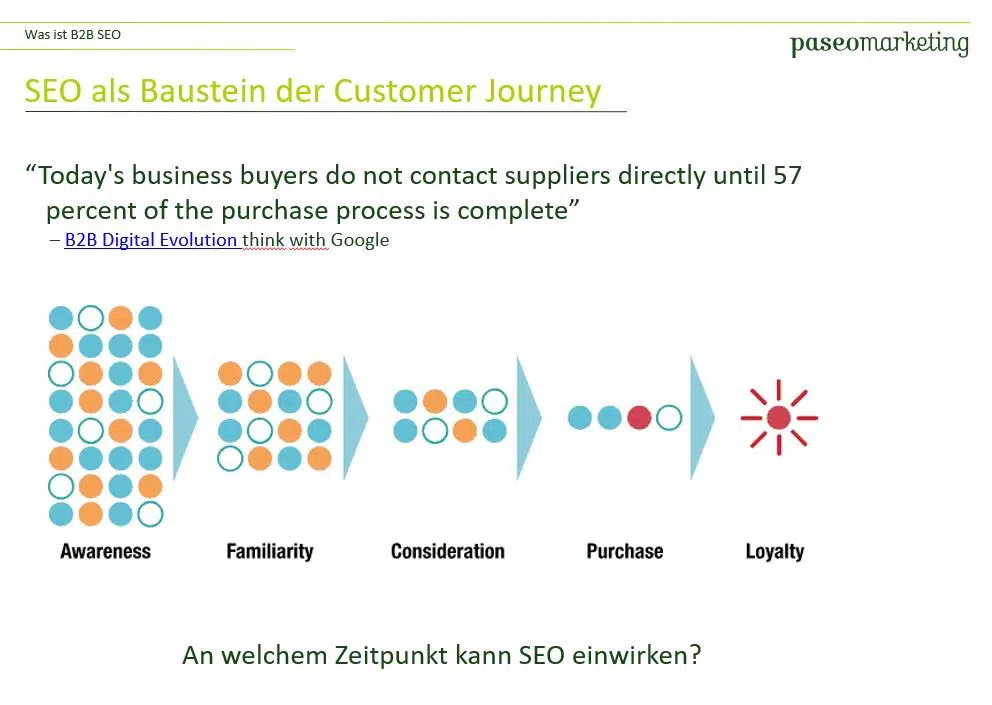
Since search intent is more “superficial” in B2C, the impulse purchases mentioned earlier often occur. In other words, some users browse online stores to let themselves be “seduced” into making a purchase. The situation is quite different in B2B. Here, you need to specifically reach a few target groups that you’ve identified in advance. It’s also worth noting that your target group won’t contact you until fairly late in the customer journey. Considerations and decisions are made internally beforehand. But you can influence this as well.
SEO for B2B: Becoming a Problem-Solver
When it comes to SEO for B2B, it’s crucial that you position yourself as a problem-solver for your target audience. You therefore need to know exactly what they want, why they want it, and what challenges your customers face. You should tailor not only your product but also your website’s content to meet these needs. This way, you’re already there for your target audience even before they make their final decision. SEO ensures that your customers actually find and recognize you as an expert online. Ultimately, your goal is to have exactly these prospects in your sales funnel and never “let them go.”
Different KPIs
The KPIs in B2C thus differ significantly from those in the B2B sector. In B2C, the focus is on revenue, profit, and cost per order. The number of new customers is important because customer loyalty is low. Another KPI is the first interaction with the brand. In the B2B sector, the situation is different. Here, the number of leads and the contracts resulting from those leads are key, which is why lead generation is so crucial. The focus is on customer lifetime value and qualified leads.
Common Mistakes in B2B Online Marketing
Online marketing is important—there’s no doubt about that. Decision-makers in companies, who often aren’t experts in online marketing, know this too. They want high-performance search engine optimization for their website. It should be perfectly optimized for Google and target their specific audience. They follow every bit of hype surrounding new developments at Google and want to implement them without thoroughly examining what’s behind them. They jump on every trend, which ultimately makes it impossible to have a clear strategy. This significantly reduces SEO success.
Wrong Approaches
Decisions regarding SEO should not be made on a whim. They must be based on comprehensive analyses, as this is the only way to successfully generate leads and achieve other search engine optimization goals for businesses. A website relaunch also plays an important role. Companies often want a new website with great content, but they don’t address SEO until after the relaunch. Another common mistake involves domain strategy.
Content maintenance is underestimated
Content is essential for effective B2B SEO. It must be tailored to the audience and of high quality. This requirement is often met, but then what? The website lies dormant. No new content is added. The Google ranking quickly drops.
Poor customer experience
The customer experience is important in the B2C sector as well. In the “Testimonials” section, companies often list endless lists of customer names—and even place them in the wrong spot. Everything is centered on the company name. Doesn’t this smack a bit of self-promotion? Exactly! And that’s incredibly ineffective for SEO. The lack of real stories makes the “References” section rather meaningless. Instead of focusing on the company name, the problem and its solution should be addressed. It’s all about the customer.
Tips for Optimizing Digital Marketing for B2C
If your customers' search intent differs from that of end customers, this should also be reflected in your company's digital marketing. This is the only way to get the most out of Google. Keywords, SEO strategy, content: Everything must be tailored to your industry and your target audience in order to attract relevant traffic. But how can you put this into practice? Here are some important tips for businesses and online marketers.
Search Engine Marketing Based on Search Intent
It cannot be emphasized enough: The target audience’s search intent is crucial. It helps determine what content needs to be on the website. To do this, it’s advisable to put yourself in the customer’s shoes. The focus, therefore, is on this question: How can I best meet user intent with my website?
Internet Marketing: The Power of Relevant Markups
The right keywords are essential for search engines like Google, but markups can also be very useful. How? By using relevant markups. Examples:
- Job Postings: Job Markup
- Training: Event Markup
- Guide - FAQ Markup
- Videos: Video Markup
Content Maintenance
There’s no such thing as online marketing without the right content. But wait! The emphasis is on “right.” This means you should delete or de-index irrelevant content. In addition, your company’s website must be regularly updated with new content. And ultimately, all content must provide real value to your target audience. Otherwise, you’ll be talking right past them.
Reflecting on Your Own Strengths in Online Marketing
Search engine optimization for B2B is complex. What does it actually look like at your company? To make progress on your own, you need to assess your current situation. Does it match your target state? No? Then it’s time to take a close look at it. Rely on expert knowledge!

Your contact person for SEO
Alexander Keller
Chief Search Architect
kontakt@paseo-marketing.de
0721 – 911010
Active since 2009 in the fields of search engine optimization, digitization, and growth hacking, I am happy to advise you on all questions relating to search engines and successful online marketing strategies.


