


Imagine your website ranks #1 on Google. Yet your traffic is still declining. Sound paradoxical? Welcome to the reality of zero-click search. More and more search queries end without a single click on an external page. The answer appears right in the search bar, generated by AI-powered summaries and chatbots. For marketers, this is a wake-up call. After all, the old equation “good ranking equals lots of traffic” no longer holds true. According to Similarweb, around 68 percent of Google searches now end without a click. This takes a serious toll on your reach. But panicking won’t help. Zero-click search is changing the rules of the game, but it isn’t ending the game. This article explains what’s behind the phenomenon. Above all, it outlines concrete strategies for visibility and reach—honestly and without empty promises.
Key Points at a Glance
- Zero-click search means that users get their answer right in the search results, without having to click at all.
- In 2026, about 68 percent of Google searches will end without a click on an external website.
- AI summaries and chatbots significantly amplify this effect. Even top-ranked sites are losing traffic.
- In the future, reach will also appear as a cited source in AI responses, not just as a blue link.
- Those who strengthen their brand, their own channels, and unique content become less dependent on Google.
What is zero-click search?
A zero-click search is a search query that does not result in a subsequent click. The user receives the desired information directly on the results page. There is no need to visit your website at all.
This phenomenon isn't new. Featured snippets, knowledge panels, and local results have long provided instant answers to many questions. Generative AI is now taking this to a whole new level. Google's AI Overviews synthesize multiple sources into a single answer. ChatGPT, Gemini, and Perplexity deliver entire texts directly in the chat.
A real-world example: A prospective client searches for “tax advisor Karlsruhe opening hours.” In the past, they would have clicked on a firm’s website. Today, Google displays the hours immediately. There’s no need to click. The same goes for definitions, comparisons, or brief instructions. The search engine is evolving from a guide to an answer machine.
This has implications for your customer journey. It often begins and ends right in the search bar. The traditional website visit as a stop along the way is no longer part of the process. You need to take this shift into account in your strategy.
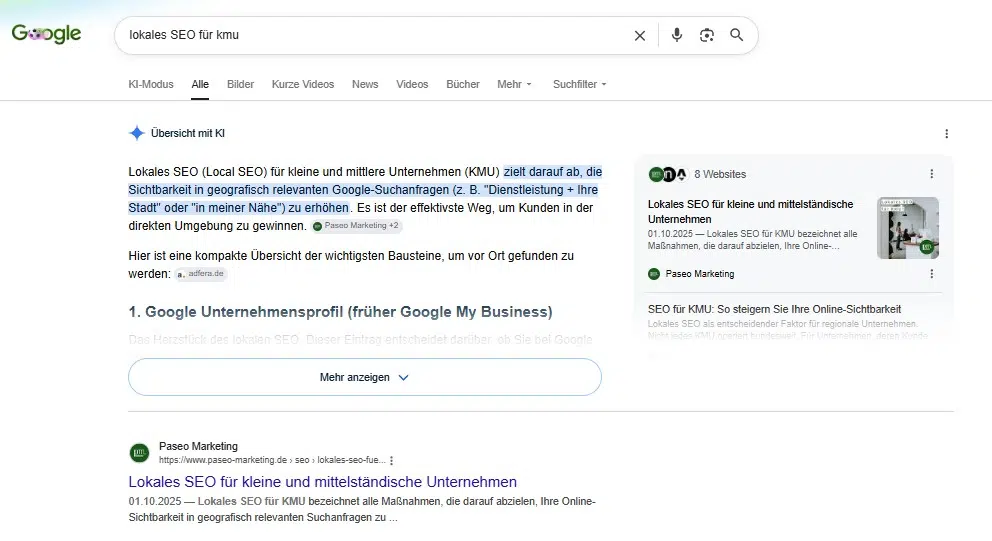
Numbers That Speak for Themselves
Numbers help contextualize the phenomenon. What’s important is to take an honest look at the data. The studies use different methods and arrive at different figures. The trend, however, is clear:
- In early 2026, 68 percent of all Google searches ended without a click. In 2024, that figure was still around 60 percent.
Source: Similarweb clickstream, analyzed by SparkToro (Rand Fishkin), via t3n 2026 - The click-through rate for the No. 1 position drops from 27 to 11 percent as soon as an AI Overview appears. That’s nearly 60 percent fewer clicks.
Source: Sistrix, analysis of over 100 million keywords on Google Germany, 2026 - Only 8 percent of users click on an organic result when presented with an AI overview. Without an AI response, that figure rises to 15 percent.
Source: Pew Research Center, approximately 69,000 real searches, 2025 - Wikipedia alone loses 31.6 million clicks per month in Germany due to AI Overviews.
Source: Sistrix, via t3n and eology, 2026 - Publishing executives expect a 43 percent decline in traffic over the next three years.
Source: Reuters Institute, survey of 280 publishing industry executives, 2026
One figure deserves special attention. The Pew study is considered particularly rigorous in its methodology. It measures actual click behavior, not extrapolated data. Its findings are more moderate than some of the figures released by agencies. This shows that the effect is real, but it tends to be dramatized depending on the agenda.
Why Zero-Click Search Is Now on the Rise
The catalyst is generative AI. Google is using AI Overviews to generate its own answers alongside search results. At the same time, search via chatbots is growing rapidly. The SE Ranking search volume for “AI search” rose from a few dozen to over 1,800 queries per month within a year. A clear sign of change.
The German Federal Association for the Digital Economy calls this a structural shift. Its “Future of Search Report 2025” describes the transition from search-based to answer-based logic. People are increasingly relying on systems to curate content for them. The traditional list of search results is taking a back seat. The association is proclaiming Generative Engine Optimization as the new benchmark for visibility.
The business magazine“brand eins ” also addresses this topic. The general consensus is that search engines are becoming less important. If you want to know something, you ask the chatbot. Companies must therefore take a different approach than they have in the past.
A lose-lose situation for publishers
This presents a dilemma for publishers. The industry news service “meedia” describes a looming lose-lose situation. AI providers train their models using third-party content. At the same time, content creators are losing traffic and advertising revenue. A model called “cost per crawl” is being discussed as a possible solution. Under this model, publishers would be compensated for the use of their content by AI agents. It remains to be seen whether this will catch on.
For small and medium-sized businesses, the situation is less dire than it is for pure-play publishers. They sell products and services, not clicks. Nevertheless, the fact remains that anyone who relies solely on Google traffic today is making themselves dependent on a single corporation.
Six Strategies for Reaching an Audience Despite Zero-Click
The good news is that you’re not at the mercy of change. Reach is generated differently today, but it’s still being generated. The following six approaches have proven effective in practice. Our article on the synergies between SEO and GEO shows how SEO and GEO work together.
1. Appear in the AI responses themselves
If the answer is the goal, you want to be the source cited. That’s exactly what Generative Engine Optimization is all about. Write clear statements instead of vague, rambling text. Back up your numbers with reputable sources. Use structured data and clear headings. AI systems favor content that they can easily understand and categorize. To learn how GEO specifically impacts small and medium-sized businesses, read our article on GEO in B2B marketing.
2. Targeting Featured Snippets and Position Zero
The answer box above the search results remains valuable. It often feeds into the AI overview as well. Therefore, phrase a question as a subheading. Immediately below that, include a concise answer of 40 to 60 words. This structure significantly increases your chances of getting a featured snippet.
3. Strengthen Your Own Brand
Brand searches are becoming more valuable. A study by ContentConsultants reveals a countertrend. While generic click-through rates are falling, brand-related searches remain stable. The reason is simple: People who know your brand search specifically for you. That’s why you should invest in brand awareness, reputation, and clear positioning.
4. Focus on channels that Google doesn't control
Become more independent. A newsletter reaches your target audience directly in their inbox. An engaged community builds loyalty to your brand. YouTube, podcasts, and LinkedIn create additional visibility. These channels are yours. No algorithm update can take them away from you overnight.
5. Prioritize transactional and local queries
Not every search ends without a click. People who want to buy or book will still click. Even local inquiries often lead to actual contact. A well-maintained Google Business Profile pays off here. Focus your budget on inquiries that show a clear intent to take action.
6. Provide depth that no AI response can replace
AI can handle superficial knowledge. But not true depth. Offer interactive calculators, your own studies, or real-world experience. Show case studies and concrete results. This kind of content can’t be summarized in three sentences. It gives users a real reason to click.

Measuring Success When Clicks Are No Longer a Factor
When clicks drop off, you’ll need new metrics. Impressions show how often you appear. Since 2025, Google Search Console has been providing initial data on AI visibility. Also, keep an eye on your brand searches. If they’re on the rise, your visibility is increasing even without direct clicks.
Specialized GEO tools can be useful. They check whether ChatGPT, Perplexity, or Gemini mention your brand. This allows you to measure your share of AI responses. Our guide to GEO tracking in AI search outlines specific methods for doing this. It’s important to remember, however, that no tool provides the whole truth. AI traffic cannot currently be accurately measured.
Most importantly:
Part of the panic is a business model. Many of the most alarming figures come from vendors who sell geolocation tools. A healthy dose of skepticism is therefore warranted.
Nevertheless, the power imbalance remains a reality. Google uses third-party content to keep users on its own site. In the first quarter of 2026, its parent company, Alphabet, reported record revenue of about $110 billion. Search advertising alone brought in over $60 billion. Publishers’ click-through rates are falling, while the company’s profits are rising.
Our advice: Don't take any shortcuts. Purchased reach or generic AI-generated text overload won't help. Focus on real substance and your own channels. It takes more work, but it lasts longer.

Rethink visibility instead of lamenting lost clicks
Zero-click search is here to stay. About two out of every three searches end without a click. Those who continue to rely solely on Google traffic will lose out. Those who understand the rules will gain new opportunities.
The path is clear. Stand out among AI-generated responses. Strengthen your brand. Build your own channels. And deliver content that no AI can replicate in three sentences. This isn’t a quick fix—it’s solid work.
It’s always worth taking a critical look. A single corporation is answering more and more questions on its own and making a fortune doing so. Become more independent. Spread your visibility across multiple channels. That way, you’ll maintain control over your reach.
Questions and Answers on Zero-Click Search
What does "zero-click search" mean?
Is SEO Dead Because of Zero-Click Search?
How do I access the AI responses from Google and ChatGPT?
What types of content still work despite zero-click?
How do I measure success when clicks are no longer a factor?
Is GEO Worth It for Small and Medium-Sized Businesses?

Would you like to prepare your company for ChatGPT, Gemini, and Google AI Overviews today?
Paseo Marketing, based in Karlsruhe, provides honest, peer-to-peer consulting to German companies, small and medium-sized businesses, and B2B "hidden champions." We don't shy away from addressing uncomfortable issues and work with you to implement solutions. Request your free initial consultation now!
Alexander Keller
Chief Search Architect
kontakt@paseo-marketing.de
0721 – 911010


